
An old man was walking through the streets of Croton, Italy — a Greek colony. The marketplace was already alive. Merchants called out to passing customers, fishermen unloaded the morning’s catch, children wove between the stalls, and potters shaped clay on spinning wheels. Somewhere nearby, a musician coaxed a melody from a lyre while another kept time on a small drum. The scent of fresh bread mingled with olive oil, charcoal smoke, and the salt air drifting inland from the sea.
He passed through the market toward the towns edge and heard the unmistakable ring of iron striking iron: the rhythmic blows of a blacksmith’s hammer. Some combinations of tones sounded rough and unsettled, while others seemed to settle effortlessly into one another, as though they belonged together. The difference was subtle, but once he had heard it, it became impossible to ignore.

Blacksmith’s forge.
Unable to satisfy his curiosity from the street, he stepped into the forge. The workshop was almost unbearably hot, and the smell of burning coal filled the room. Around him, blacksmiths moved with practised confidence, heating bars of iron until they glowed orange before shaping them into tools, hinges, nails, and horseshoes. Every blow of the hammer sent another tone into the air.
The blacksmith indulged the curious man, and together they began comparing the hammers. Some were larger and some smaller. Some felt heavier in the hand than others. He discovered that the hammers producing the most beautiful consonances stood in remarkably simple numerical relationships. One weighed twice as much as another, producing what musicians now know as the octave.
The man in this old legend is Pythagoras. Born on the Greek island of Samos around 570 BCE, he later established a philosophical and religious community at Croton in southern Italy. No writings by Pythagoras survive, and much of what later generations said about his life became inseparable from legend, but the community associated with him profoundly influenced the development of mathematics, philosophy, music, and cosmology.

This detail from Raphael's "The School of Athens" depicts the ancient Greek philosopher Pythagoras writing in a large book.
For Pythagoras, the sounds of the forge were not merely an interesting observation. They suggested that beauty might possess an underlying structure and that musical consonance might be governed by relationships that could be expressed in number. Number was not simply a tool for counting sheep or measuring fields. It was a principle through which the order of the universe might be understood. Music offered an audible example of a much larger possibility: that the natural world was not chaotic, but arranged according to patterns and proportions waiting to be discovered.
The Music of the Spheres
Over the centuries, later philosophers and writers expanded this vision into one of the most enduring images in Western thought: the music of the spheres. The planets, they imagined, moved through the heavens according to perfect mathematical proportions, producing a celestial harmony too vast for human ears to perceive. The orderly movements of the cosmos and the consonant intervals of music were understood as expressions of the same numerical principles.

Earthrise photograph of Earth taken from lunar orbit by astronaut William Anders on December 24, 1968, during the Apollo 8 mission.
Whether understood literally or metaphorically, the music of the spheres expressed a profound conviction: beauty, order, mathematics, and music were not separate subjects, but different ways of encountering the same reality. The relationships heard between tones offered a glimpse of the relationships that held the universe itself together.
A Winter Day at Festival du Voyageur
I live in Winnipeg, Manitoba, a city shaped by rivers. At The Forks, the Red and Assiniboine Rivers meet on the original lands of the Anishinaabe, Cree, Oji-Cree, Dakota, and Lakota peoples, and the National Homeland of the Red River Métis. For thousands of years, these waterways supported travel, trade, and cultural exchange. Later, they became central routes in the fur trade that connected Indigenous hunters, Métis families, voyageurs, and European trading companies with markets overseas.

Braiding history and community together through the traditional giant Ceinture Fléchée (arrow sash) dance.
Each February, Festival du Voyageur remembers that history through music, food, dancing, and historical demonstrations at Fort Gibraltar. On the day I visited, the temperature was close to minus forty. Bundled in snow boots, long underwear, a heavy jacket, mitts, a scarf, and a toque, I moved from cabin to cabin, grateful for the warmth inside each one.
Then I entered the blacksmith’s shop. The forge was intensely hot, and the blacksmith worked a length of glowing iron at the anvil. At first I heard only the sharp crack of steel against iron. Then I noticed a second sound: a clear pitch that rang after every blow and lingered in the air before fading.

A blacksmith working on a demonstration at Fort Gibraltar during the Festival du Voyageur in Winnipeg.
Once I heard it, I could not stop hearing it. Each strike contained both the attack of the hammer and the resonant voice of the iron. Standing there in the heat of the forge while the prairie winter pressed in outside, I thought of Pythagoras. Whether or not he ever entered a blacksmith’s shop, I suddenly understood the legend.
What Did Pythagorus Really Do?
Like many stories told for centuries, the legend of Pythagoras and the blacksmith contains both truth and fiction. The earliest surviving version was written more than six hundred years after Pythagoras lived, and the physics do not work as the story claims. The pitch of an anvil is not determined by the weight of the hammer striking it.
Still, the legend preserves an important question: why do some combinations of tones sound like they fit together while others don’t fit together.
The historical Pythagoras is difficult to separate from the legend. He left no writings of his own, and most accounts of his life were written much later. We do know that he founded a philosophical community in southern Italy and that music, mathematics, and the order of the natural world were closely connected in the Pythagorean tradition.
The real discovery probably came not from a forge, but from a vibrating string.
When a string is divided into simple proportions, it produces familiar musical intervals.
Try This At Home
Sound a string. You can do this on a guitar or violin right now.
Now divide the string in half and sound it again. This produces a pitch one octave higher.
Divide it in half once more, so that only one-quarter of the original string is vibrating. Sound it again, and you will hear another octave.
Next, divide the original string into three equal parts and sound one-third of it. This produces a pitch an octave and a perfect fifth above the original.
Finally, divide the original string into five equal parts and sound one-fifth of it. This produces a pitch two octaves and a major third above the original.
These are among the first relationships in the harmonic series: the octave, the fifth, and the major third, all emerging from simple divisions of a single vibrating string.
Greek Harmonic Thinking
Pythagorus was proababaly experimenting on the monochord: a single string stretched over a resonating box.
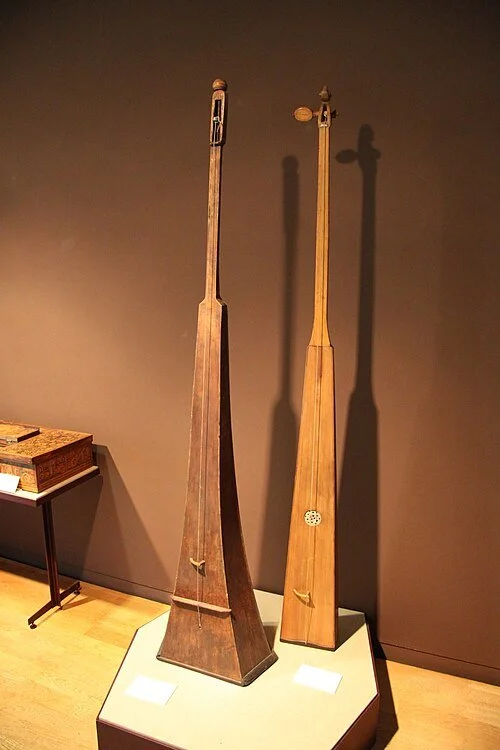
Monochords at the Musical Instrument Museum, Berlin.
By moving the bridge, musicians and philosophers could divide the string precisely and hear the resulting intervals. Whether Pythagoras invented it is uncertain, but the monochord became one of the central tools of Greek harmonic science.
The importance of the discovery that harmonic realtionships were goverened by simple mathamatical ratios went far beyond a few pleasant music. It suggested that sound followed mathematical laws and that music could reveal something about the structure of the natural world.
Later thinkers expanded the idea. Plato connected musical proportion with the order of the cosmos. Aristotle preserved many of the Pythagoreans’ ideas. Nicomachus recorded the blacksmith legend, and Boethius carried Greek harmonic theory into the medieval world, where music was studied alongside arithmetic, geometry, and astronomy as part of the quadrivium.
The legend, then, is wrong in its details but right in its ambition. Pythagoras probably did not discover musical ratios by weighing hammers. But the Pythagorean tradition did uncover something remarkable: some of the most beautiful relationships between tones arise from the simplest mathematical proportions.
The next question is why.
Why does a ratio of two to one produce an octave? Why does three to two sound so stable? To answer that, we have to leave philosophy behind and turn to the physics of sound.
From Number to Sound
The Pythagoreans discovered that musical intervals could be expressed as simple ratios, but a ratio written on a page does not make a sound. To understand why these proportions produce the tones they do, we have to look at what happens when something vibrates.
Sound you string again. The string moves rapidly back and forth, disturbing the surrounding air and creating waves of pressure. Those waves travel outward until they reach our ears.
The speed of the vibration determines the frequency of the sound. A string vibrating 220 times each second produces a frequency of 220 hertz. If it vibrates twice as quickly, at 440 hertz, we hear the tone one octave higher.
Now divide the string in half and sound it again. Because the vibrating portion is only half as long, it vibrates twice as quickly and produces the octave at 880 hertz.
Divide it in half again, leaving one-quarter of the original string. It vibrates four times as quickly and produces another octave.
Next, divide the original string into three equal parts and sound one-third of it. That portion vibrates three times as quickly as the original. The resulting tone is an octave and a perfect fifth above the first or 660 hertz.
Divide the string into five equal parts and sound one-fifth. It vibrates five times as quickly and produces a tone two octaves and a major third above the original or
This sequence—one, two, three, four, five, and onward—is the beginning of the harmonic series. It is not simply a pattern produced by carefully dividing a string. In many musical sounds, these vibrations happen simultaneously.
When a string sounds, it vibrates along its entire length, producing the fundamental frequency. At the same time, it also vibrates in halves, thirds, quarters, fifths, and increasingly smaller divisions. These secondary vibrations produce quieter tones above the fundamental called harmonics or partials.
The first few partials give us an octave, a perfect fifth, another octave, and a major third. Together, they begin to form something remarkably close to a major chord. These relationships are not imposed upon sound by a theory book. They arise from the way strings, air columns, and many other physical objects naturally vibrate.
This is one reason the Pythagorean ratios mattered so much. The ratios did not merely describe distances between tones. They revealed patterns already present within musical sound itself.
But the presence of those patterns in nature raises another question. Why are human beings able to hear and organize them so readily?
The answer begins inside the ear.
Built to Hear Relationships
The Pythagoreans discovered that the most consonant musical intervals correspond to remarkably simple numerical relationships. Modern science allows us to ask a different question: why are we so good at hearing them?
Part of the answer lies deep inside the ear.
Hidden within each cochlea is the basilar membrane, a delicate structure that separates incoming sounds according to their frequencies. High frequencies produce their greatest vibration near the base of the cochlea, while lower frequencies travel farther before reaching the place where they resonate most strongly. In effect, every pitch has its own address along the membrane, creating what neuroscientists call a tonotopic map of sound.
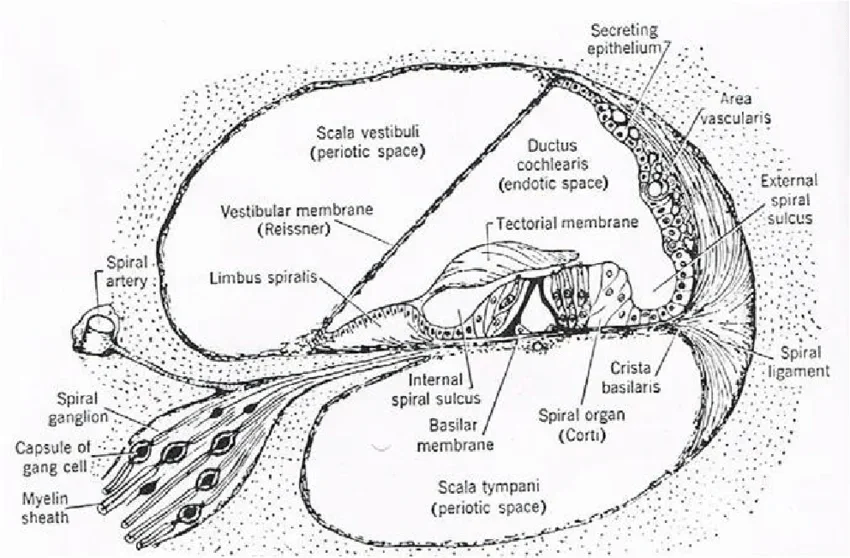
Cross section of the cochlea. The organ of Corti is located on the basilar membrane in the Scala media ductus cochlearis. (Stevens 1951).
This arrangement is approximately logarithmic, meaning that equal frequency ratios occupy roughly equal distances along the cochlea. A tone at 220 Hz, 440 Hz, and 880 Hz therefore forms a regular pattern because each frequency is related by the same simple ratio of 2:1.
The cochlea does more than sort frequencies. Every musical note contains a family of quieter frequencies called harmonics or overtones. Strike a piano key and the string vibrates not only as a whole, but simultaneously in halves, thirds, quarters, and many other fractional divisions. These vibrations produce the harmonic series, a sequence of frequencies related by simple whole-number multiples.
Our auditory system is remarkably well adapted to these naturally occurring patterns. As sound travels from the cochlea through the auditory brainstem and into the auditory cortex, the brain groups these harmonics together, allowing us to perceive them as a single musical sound rather than dozens of independent frequencies. This ability helps us recognize pitch, distinguish one instrument from another, and even hear a “missing fundamental” when the lowest frequency is absent but its overtones remain.
It would be inaccurate to say that the cochlea is built from the harmonic series. The harmonic series is a property of vibrating objects, while the cochlea is a biological organ that evolved over millions of years. Yet there is something profoundly elegant about their relationship. The physical world naturally produces sounds rich in harmonic overtones, and the human auditory system has evolved to detect and organize exactly those kinds of sounds with extraordinary efficiency.
Long before we learn scales, harmony, or music theory, we are already hearing relationships. They are woven into the sounds around us and into the remarkable organs that allow us to hear them.
Perhaps that is why the question first posed in the legendary blacksmith’s forge still feels so compelling today:
How do tones fit together?
Sources
Casale, Jarett, Patricia F. Kandle, Ian V. Murray, and Najib I. Murr, “Physiology, Cochlear Function,” in StatPearls [Internet], Treasure Island (FL): StatPearls Publishing, Last Update: April 1, 2023, URL = https://www.ncbi.nlm.nih.gov/books/NBK531483/.
Huffman, Carl, "Pythagoras", The Stanford Encyclopedia of Philosophy (Spring 2024 Edition), Edward N. Zalta & Uri Nodelman (eds.), URL = <https://plato.stanford.edu/archives/spr2024/entries/pythagoras/>.
Huffman, Carl, "Pythagoreanism", The Stanford Encyclopedia of Philosophy (Summer 2024 Edition), Edward N. Zalta & Uri Nodelman (eds.), URL = <https://plato.stanford.edu/archives/sum2024/entries/pythagoreanism/>.
OpenStax, Biology, “36.4 Hearing and Vestibular Sensation,” OpenStax, Houston, TX, URL = https://openstax.org/books/biology/pages/36-4-hearing-and-vestibular-sensation.