
COMING SOON! Forever-Free Workshop: Introduction to Partimenti
Why So Many Musicians Feel Stuck
I’ve been talking with a lot of musicians lately who are deeply curious about partimenti. Many of them have done exactly what a motivated musician would do: they’ve gone hunting in sources, browsed partimenti.org, and spent time working with Fenaroli (or other collections of bass lines and rules), trying to figure out how to begin. Many are also trying to connect what they learned in music theory training with what they’re seeing in partimenti.
And I keep hearing the same experience: lots of very capable and skilled musicians feel stuck.
Part of the difficulty is that, although partimenti sits at the foundation of so much of the great classical repertoire we study—Mozart, Beethoven, Bach, and many others—the method itself now feels deeply countercultural. Learning through sound first, working with patterns, realizing music above a bass line, improvising as part of daily musical life — this runs against how most classical musicians are trained today. Improvisation today is at best neglected, and at worst actively discouraged or frowned upon (there are several wonderful and notable exceptions to this).
Yet historically, this pattern-based, improvisatory way of learning wasn’t an optional supplement. It was the foundation.
The Missing Beginning
Part of the reason for this is simple: partimenti was an oral tradition. So much of the earliest training was passed from teacher to student in the moment—by playing, singing, copying, and responding—rather than by written explanation. Most of what mattered most was never captured on the page.
This is also why the music theory many of us learned in school doesn’t always line up neatly with what we see in partimento sources. Modern theory often explains music after the fact. Partimenti trained musicians from the inside—through sound, pattern, and gesture first, explanation second—in the moment.
What I’ve come to realize (and what I think many modern learners feel immediately) is that many of the surviving partimento sources start in the middle. Fenaroli and other collections often assume you already have a working grasp of foundational patterns—cadences, the Rule of the Octave, sequences—before you ever touch the first “real” basses.
Becoming fluent with cadences and the Rule of the Octave, for a dedicated engaged amateur takes about 6 months.
How Students Originally Learned
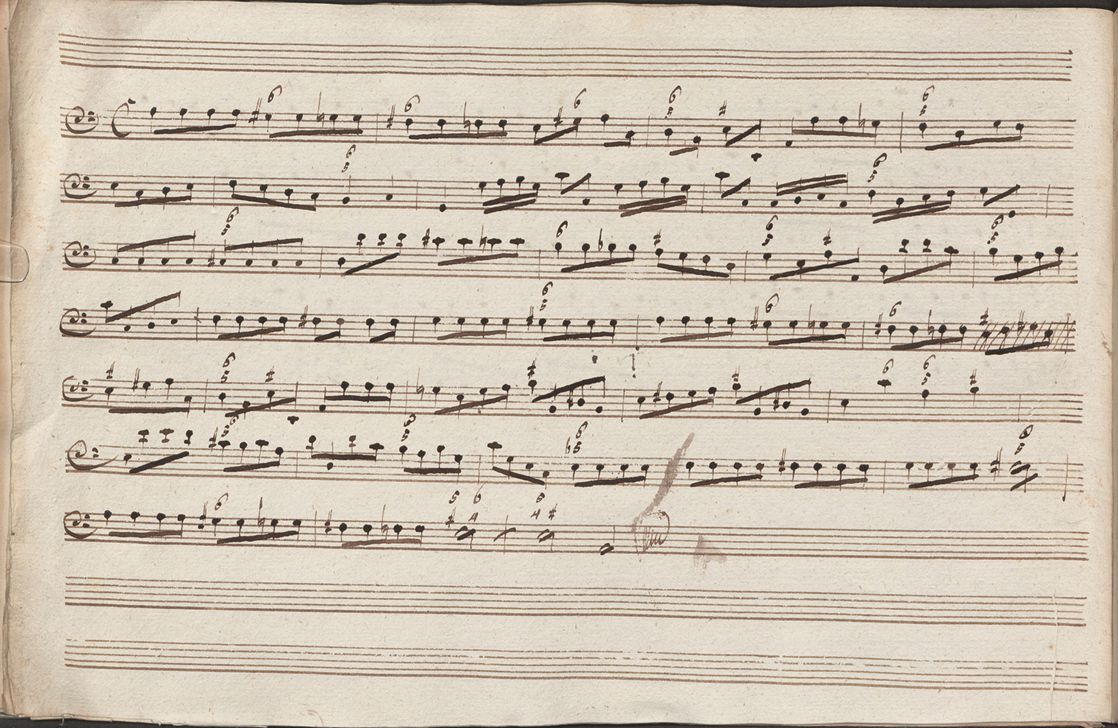
They built it slowly—often starting with short bass lines and small chunks of patterns written on chalkboards—until those patterns were fluent enough to apply to longer, more complex partimenti that would have been copied into a book of manuscript paper.
Much like the music itself, the chalk dust from those early lessons has largely been lost to history.
COMING SOON
Introduction to Partimenti: From the Chalkboard
What I’m aiming to do in my forever-free workshop Introduction to Partimenti: From the Chalkboard is recreate, in a modern way, what those early stages might have felt like: working with short bass lines, copying patterns, building fluency gradually, and letting sound lead the learning.
We start where many modern musicians actually need to start, not where Fenaroli started.
We’ll begin with the foundational bass motion: ①–⑤–① and build collections of usable intervals over those bass notes.
From there, we’ll begin adding two more building blocks:
scale degree ④ from the Rule of the Octave
and the ⬇4 ⬆2 sequence
To support your practice, you’ll also work with a set of 32 bass lines in C, F, G, B♭, D major, and A, D, E, G, B minor — all designed to reinforce these patterns in real musical contexts.
You’ll also have access to dozens of intavolature — short pieces directly connected to partimento — that show what these patterns can become. Some will be notated, and some will be delivered orally, the way this tradition was originally transmitted.
How the Workshop Works
Most of the workshop will look like this:
You pick a pattern to work on.
I play — you respond.
I play — you respond.
You take a moment to reflect on what you just played. Then repeat.
We build fluency through sound first. Then we pause briefly to reflect before going back to making music.
You'll Have Friends Along The Way
And you won’t be doing this alone.
Historically, partimenti was always taught in community. In Naples, a maestro would teach more advanced students, and those students would, in turn, pass those lessons on to younger musicians. Learning happened in layers—through listening, imitation, correction, and shared practice. Musical fluency wasn’t built in isolation; it was cultivated within a community of insiders who understood both the patterns and the process.
This is incredibly powerful musical learning, but it isn’t easy, so you need friends along the way.
Introduction to Partimenti: From the Chalkboard will be supported by an online community. I’ll be listening and responding to recordings of your realizations and pattern work. Participants will be able to hear one another, respond, and encourage each other. The goal isn’t just individual progress—it’s shared fluency.
This Is Just the Beginning
This introduction is really just the beginning of the larger Partimenti Workshop. The Partimenti Workshop will be built along similar lines, gradually helping you internalize the harmonic and contrapuntal patterns found in historical partimenti. You’ll start by applying these patterns to bass lines I’ve composed specifically for learning, and later move toward historical basses and even bass lines drawn from repertoire — from Corelli through Brahms and later. Later, there will also be specialized workshops focused on composing with partimenti, teaching with partimenti, and other related topics. This introduction is simply the first doorway into a much larger Partimenti Workshop ecosystem that’s steadily taking shape.