
Sound Before Sight
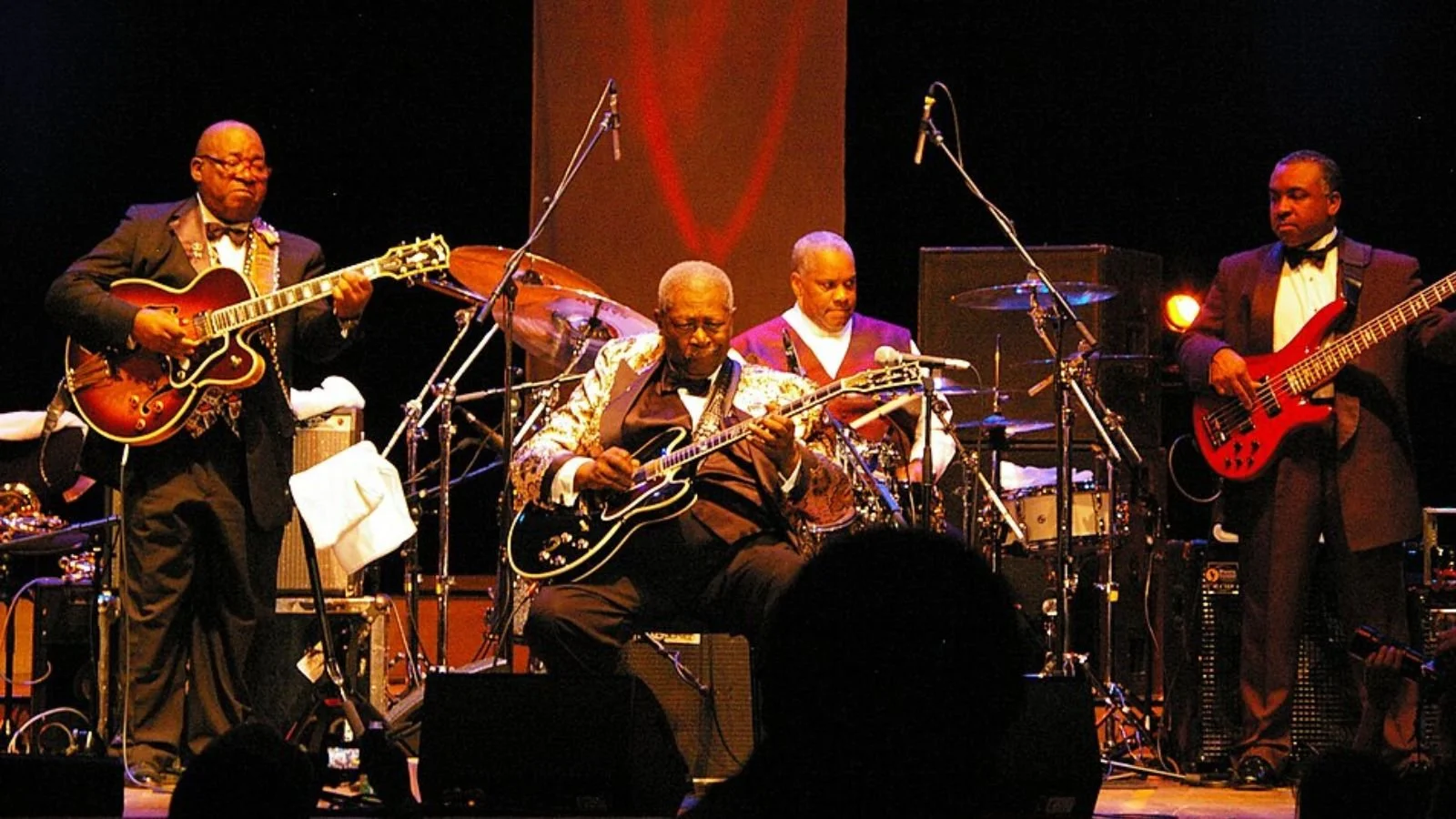
"The King of the Blues: B.B. King and His Band in Concert"
Blues legend B.B. King performs with his signature Gibson guitar, 'Lucille.' A tireless performer who played over 200 shows a year well into his 80s, King’s sophisticated soloing and heartfelt vocals defined the sound of modern electric blues for generations.
A Blues Lesson That Changed My Thinking
A few years ago, a student walked into my studio and said, “My dad told me there’s something called the blues scale.”
She sat down at the piano and played the first four notes of the C blues scale: C, E♭, F, F♯.
I said, “Yes — that’s the C blues scale.” I played those same four notes back to her, then added a short lick using them. She answered. I started on F♯ and descended through the scale; she answered again. I went down once more, adding a B♭ this time; she responded. Then I played C–B♭–G, and again she answered.
For several minutes the lesson became pure call and response. I played a blues idea, she responded. She played an idea, I responded. No explanations, no notation — just listening and musical conversation.
Learning Through Sound
Because of her curiosity, we pushed further. By ear, I showed her the bass line of a 12-bar blues. Still without any score, we worked out the voice leading of C7 to F7 to C7, then G7 to F7 to C7. Once she felt comfortable with the scale, bass line, and chords, we began shaping simple question-and-answer phrases.
Along the way we listened to great players — B.B. King, Eric Clapton, Miles Davis — letting their phrasing and sound guide our ears.
At no point did we use notation.
A Partimenti Revelation
When I later returned to my study of partimenti, I had a small but powerful realization: this blues lesson mirrored historical partimento practice almost perfectly. The order was sound first, understanding second, notation last.
That was very different from how I had been trained, where notation often came first and improvisation, if it appeared at all, came later.
In partimenti teaching, the process often looks like this:
I play — you copy.
I play — you copy.
Then we pause briefly to name what we’ve just done, usually using two simple tools: scales and intervals.
Then we return to sound:
I play — you copy.
Eventually, you play — I copy.
Patterns are first absorbed through the ear, then clarified intellectually, and finally embodied physically at the keyboard.
Up to that point, notation still isn’t necessary.
Why Sound Comes First
This sequence reflects a simple principle:
Sound comes first. Understanding follows. Notation arrives later as a way of naming and preserving something we already know.
Notation is incredibly useful — essential, really — but it works best as a tool for memory and communication, not as the starting point of musical understanding.
When sound leads, music tends to feel more flexible, expressive, and intuitive. Students often become less self-conscious, more curious, and more willing to experiment. Ideas emerge more freely because the emphasis shifts from correctness to listening.
Beyond Blues, Beyond History
That lesson didn’t just shape how I teach blues or improvisation. It fundamentally changed how I approach partimenti, repertoire, theory, and musical learning more broadly.
Whether we’re working with Baroque bass lines, Classical repertoire, jazz harmony, or contemporary composition, the principle holds surprisingly well:
Hear first.
Play next.
Understand gradually.
Write it down when needed.
Sound before sight.